> For the complete documentation index, see [llms.txt](https://guides.animl.camera/llms.txt). Markdown versions of documentation pages are available by appending `.md` to page URLs; this page is available as [Markdown](https://guides.animl.camera/introduction-to-real-time-wireless-camera-trapping.md).
# Introduction to real-time wireless camera trapping
Lessons learned from deploying and managing wireless camera trap networks in remote environments
## Background
Since 2018, The Nature Conservancy of California's [Conservation Tech Team](https://www.nature.org/en-us/about-us/where-we-work/united-states/california/stories-in-california/advancing-conservation-through-technology) has been using wireless camera trap networks in service of various conservation problems that benefit from real-time camera trap imagery. Our primary pilot site for this technology has been [Santa Cruz Island](https://www.nature.org/en-us/get-involved/how-to-help/places-we-protect/santa-cruz-island-california/), a 96-square-mile island located off the coast of Southern California, where we partnered with TNC's [Island Resilience Team](https://www.nature.org/en-us/about-us/where-we-work/united-states/california/stories-in-california/california-oceans-program/#island-resilience) to deploy camera networks as a monitoring and early-detection system for invasive species. For an in-depth overview of that project, check out the video below and its feature in [Wired](https://www.wired.com/story/rats-are-invasive-menaces-these-cameras-spy-on-them/).
We are now in the process of scaling this approach to other preserves, but a lot of the applicable use-cases (e.g. [biosecurity](https://en.wikipedia.org/wiki/Biosecurity), [human-wildlife conflict](https://en.wikipedia.org/wiki/Human%E2%80%93wildlife_conflict)) are global in nature, and we can't do it all ourselves. We hope that by sharing some of the lessons we've learned, this document might serve as a resource for other organizations and researchers who are interested in using wireless camera traps for conservation. Our goal is to provide folks with a framework to weigh costs and benefits, get off the ground quickly, and minimize costly experimentation and evaluation.
If you have questions, corrections, or suggestions–please [reach out](/about-us/contact-us.md)! We intend for this to be a living document and to update it as the technology and our experience develops.
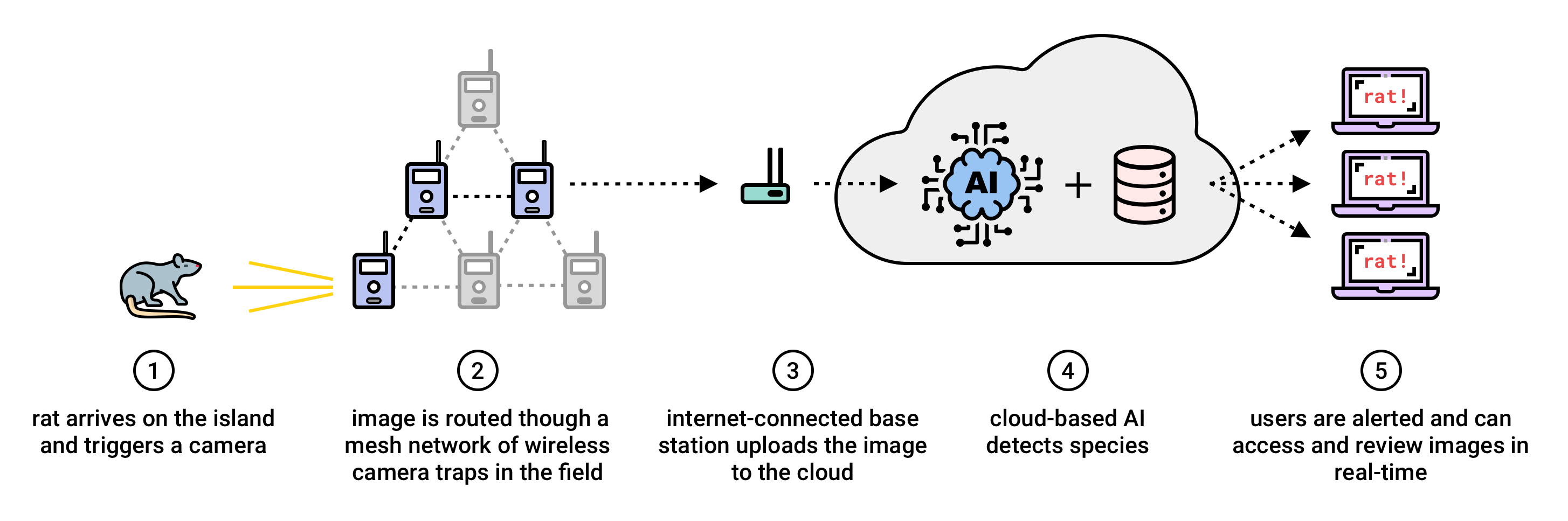
Diagram of how The Nature Conservancy's invasive species monitoring system works on Santa Cruz Island
{% embed url="" %}
From Months to Minutes: Real-time Biosecurity Monitoring with Wireless Camera Traps & AI
{% endembed %}
{% hint style="info" %}
**DISCLAIMER OF ENDORSEMENT**
Reference herein to any specific commercial products, process, or service by trade name, trademark, manufacturer, or otherwise, does not necessarily constitute or imply its endorsement, recommendation, or favoring by The Nature Conservancy.
{% endhint %}