> For the complete documentation index, see [llms.txt](https://guides.animl.camera/llms.txt). Markdown versions of documentation pages are available by appending `.md` to page URLs; this page is available as [Markdown](https://guides.animl.camera/tnc-wireless-camera-trap-documentation/intro.md).
# Intro
Documentation on how to replicate and maintain the same wireless camera trap systems The Nature Conservancy utilizes on its preserves
## Who this documentation is for
The following documentation is for TNC staff who are actively scaling and managing wireless camera trap networks and using [Animl](https://animl.camera) for data processing, and for anyone interested in replicating similar systems elsewhere!
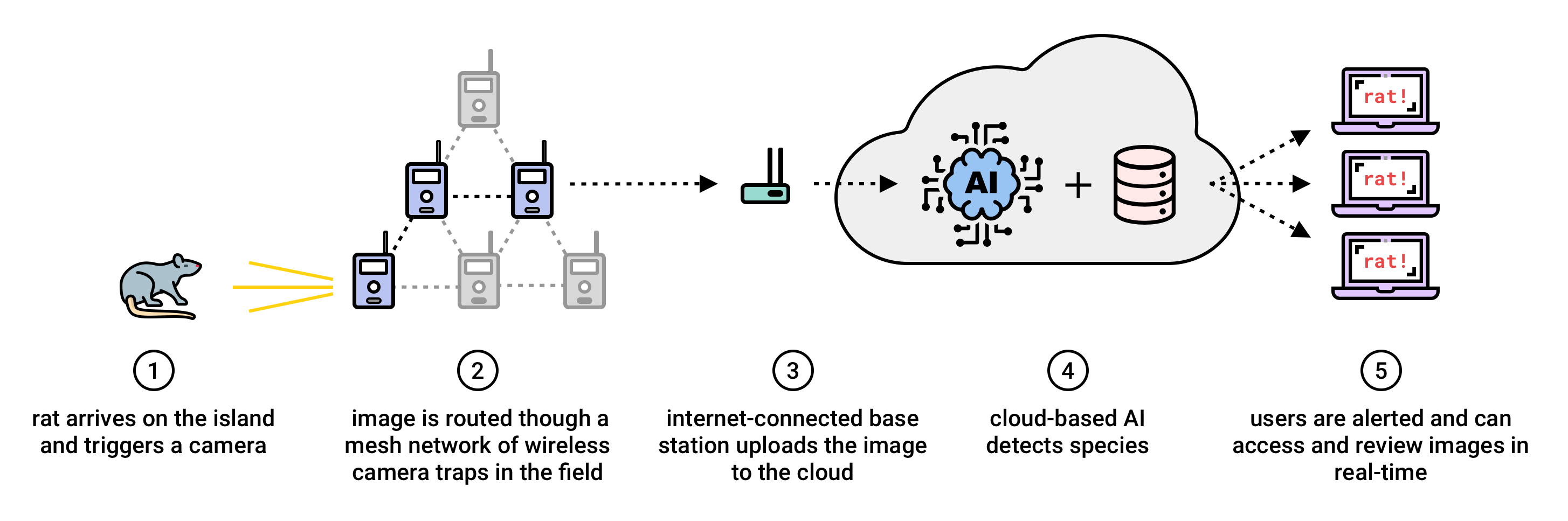
The system we use integrates [locally-networked, radio-based camera traps](/fundamentals/types-of-wireless-camera-traps.md#locally-networked-radio-based-camera-traps) (Buckeye X80s) and cellular camera traps ([RidgeTec Lookout 4G LTEs](https://www.trailcampro.com/products/ridgetec-lookout-4g-lte)) with [Animl](https://animl.camera), a software platform we've developed for managing camera trap data and performing machine learning inference in the cloud.
Diagram of how The Nature Conservancy's invasive species monitoring cameras work on Santa Cruz Island
This documentation is meant to supplement the existing product documentation published by the camera manufacturers, provide specific guidance for integrating these types of cameras with Animl, and share lessons-learned/best practices for long-term deployments in the field.
{% hint style="info" %}
**Access to Animl**
If you're interested in using Animl for data processing and managment for your project, please reach out to Nathaniel Rindlaub at \.\@tnc.org
{% endhint %}